

The Secret to Building a High-Performing Culture
Culture. You can’t see it, you can’t touch it, but you can definitely feel it. When it’s good, it’s energising — people lean in, collaborate, innovate. When it’s toxic, it drains performance faster than any strategy or process problem.
Over the past few months, I’ve reviewed 20 of the best books on organisational culture — from Edgar Schein’s classics to Daniel Coyle’s Culture Code, from Jim Collins’ Good to Great to Amy Edmondson’s work on psychological safety.
The patterns are clear: culture isn’t just a “nice to have.” It shows up in your P&L, your attrition rate, your customer feedback, and even how regulators see you.
So, if you lead a team, a department, or an entire business unit, here’s what you need to know.
Six Signs Your Culture Might Be Working Against You


Blame Culture – When mistakes get punished, it drives problems underground. Your people will protect themselves; this could be hiding issues instead of fixing them, or they throw mud to divert attention from themselves.
Fear Culture – Have you ever thought that people seem to be telling you precisely what you want to hear? It suggests that they are fearful of consequences if they say something you don’t like or that may raise unexpected issues or surprises. No leader likes surprises. When people tell leaders what they want to hear, not what needs to be said, it exposes leaders to bigger problems down the line.


Silo Culture – Silos are not necessarily a bad thing. However, if functions fail to communicate and collaborate, they leave things open to interpretation. These assumptions cause avoidable wasted effort and duplication.
Overwork Culture – I once worked in a culture where the person who sent the latest email was considered the winner. It led to emails as late as 2 or 3 AM!!! This behaviour sets an unhealthy and unrealistic expectation that you are “Always on.” It leads to stress and burnout, yet leaders often confuse it or disguise it as a way to demonstrate commitment.

Complacent Culture – If your culture is nice and comfortable, no pressure, your people become bored, even stagnant, which means innovation dies, or worse, when you do need to raise the pace, your people can’t raise their game.
Hero Culture – Is your team blessed with a few stars who have the knack of “getting you out of jail” and “saving the day”? An over-reliance on them, and you fail to address the systemic issues that are causing this dependency.

Why Culture Really Matters

- Economics: Gallup’s research across 100k+ teams shows that top-quartile engagement drives +23% profitability, +18% productivity, and −81% absenteeism. On the other hand, disengagement costs the global economy approximately US$8.9 trillion — 9% of global GDP.
- People: Toxic culture was 10× more predictive of attrition than pay during the Great Resignation (MIT Sloan). Replacing a mid-salary employee costs ~£30k.
- Operations: Highly engaged teams see −64% safety incidents and −41% defects. That’s quality and safety tied directly to culture.
- Reputation: Edelman’s 2025 Trust Barometer shows trust is now as powerful a purchase driver as price. Great cultures don’t just keep employees — they attract customers, candidates, and partners.
What Great Cultures Do Differently
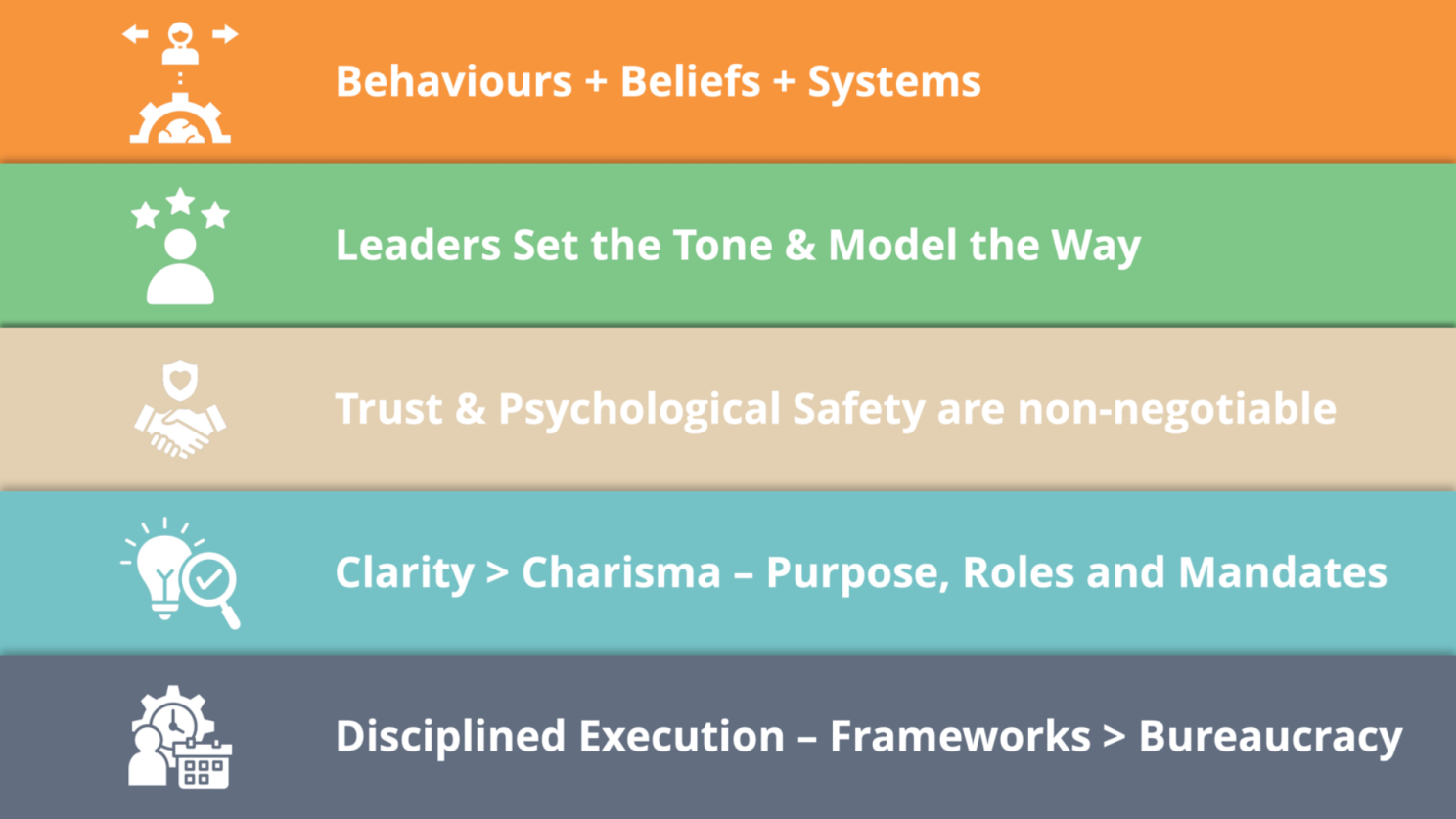
Across all the research, five themes stood out:
-
Culture is a system – behaviours, beliefs, and systems have to line up.
-
Leaders set the tone – through what they model, measure, and reward.
-
Trust and psychological safety are non-negotiable – for speed, learning, and innovation.
-
Clarity beats charisma – clear purpose, roles, and decision rights consistently outperform heroics.
-
Disciplined execution wins – freedom within a framework avoids both chaos and bureaucracy.
The Culture Puzzle

If you are looking for one “perfect” culture, I hate to disappoint you; there isn’t one – there’s no silver bullet.
What’s right for a start-up might be an adhocracy (a flexible and informal organisation), but it will still need elements of hierarchy (ranked by status and/or authority) as it scales.
A bank may rely on hierarchy to maintain compliance, but without adhocracy, it will struggle to innovate in a digital and increasingly AI-influenced world.
Consider a global retailer that might succeed with a market culture (results-driven, market-oriented, and very competitive) but benefit from elements of a clan culture (strong sense of community, collaboration and trust) to keep employees engaged.

So, what does this mean for you?
- What behaviours am I modelling?
- What elements of our culture help or hinder performance?
- Are you treating culture like an asset — something you invest in and measure — or just hoping for the best (the ‘wing and prayer’ method)?
Further Information
If you’re looking to build or elevate your team culture, download our ‘Build Your Culture’ Toolkit, packed with practical tools you can implement immediately to move the dial on your culture.

Webinar: The Culture Advantage.
Let’s Talk Culture
Do you want to discuss how to elevate your culture and build consistent high performance? Why not book a call and explore how we can help?