In another of our revisited episodes, Ricky looks back on Podcast 133, where he and Paul explore the idea of having a ‘bad boss’ and how sometimes this is more about the perception of the manager’s style than about the manager’s capability.
Ricky asks us to differentiate between toxic behaviours (which are not as common as many people think) and one of the more common perspectives: the boss is just being tough yet reasonable, or the boss is just a little disorganised, leading to ambiguity.
In this shorter-than-usual episode of the podcast, Paul heads back to one of our early podcasts (no 84) that looked at the well-known RACI model. This model helps people understand the different roles in decision-making and task allocation.
Paul thinks the Consulted and Informed roles, and how sometimes the Accountable person has to manage the emotions and expectations of these groups, so that they don’t hold the project hostage to their perspective, yet remain unaccountable to the outcome.
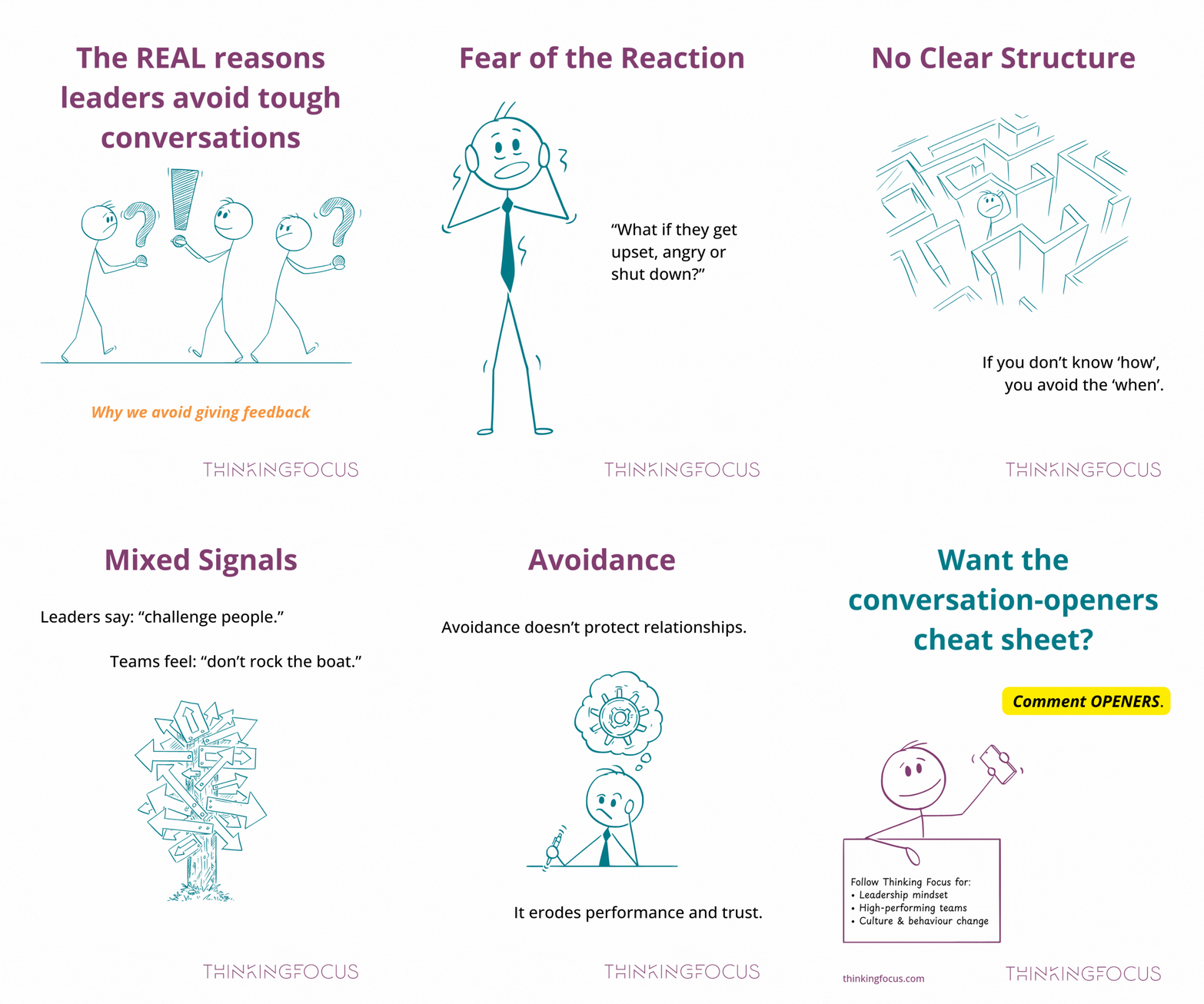
Most leaders don’t avoid tough conversations because they lack courage. They avoid them because they don’t feel equipped to handle them.
Since my last carousel exploded on LinkedIn, I’ve read the comments, messages, and DMs… and a clear pattern is emerging. I’ve sent our countless one-page manager’s guides and am now developing a full-on Feedback Guide for Leaders.
Add your information in the contact us section if you want a copy when it’s ready.
Here are the 5 real reasons leaders avoid behavioural feedback:
1️⃣ Fear of the reaction “What if they get emotional, upset, angry, or shut down?”
2️⃣ Fear of getting it wrong “I don’t want to make it worse.”
3️⃣ Not having a clear model or structure When you don’t know how to have the conversation, you avoid it.
4️⃣ Mixed cultural signals Leaders say: “Challenge people.” Teams feel: “Don’t rock the boat.”
5️⃣ Past experience One messy conversation years ago is enough to create hesitation now.
Here’s the truth:
Avoidance doesn’t protect relationships. It erodes performance, trust and engagement.
To help leaders and managers take that difficult first step and get the conversation started, we’ve created a cheat sheet with 7 ways to open the conversation. We share it with them in workshops to add to their toolkit.
Coaching can be one of the most rewarding conversations you ever have with someone — even when it starts with a call out of the blue asking for help.
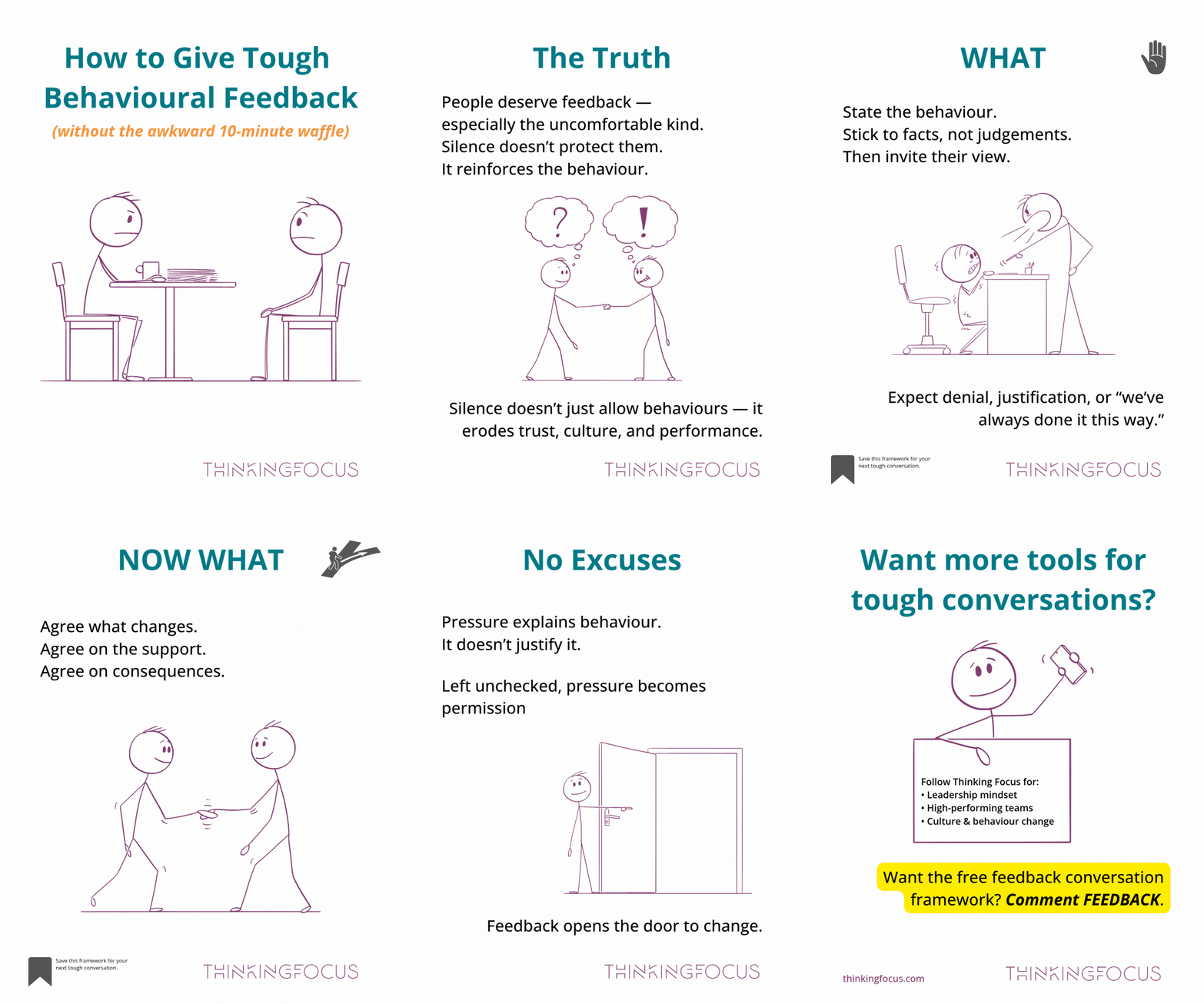
One of the toughest things leaders face is giving behavioural feedback to someone who has fallen short of the standard. And often, you’re only giving it because everyone else has ducked the job.
Not because they don’t care — but because they don’t have the skills, the confidence, or the nerve to handle whatever reaction comes back.
I get it. I’m usually the one people call when the conversation feels too big or too risky. I know what it’s like to deliver the message others are scared to give… and I know what it’s like to take someone who reacts badly and help them become a high-performing leader.
So when an HR Director rang to sense-check how they should tackle a difficult team leader — someone creating pressure, fear, and a steady stream of people eyeing the exit — I was happy to help.
No one should feel like that at work.
Here’s what I shared with them.
1. People deserve feedback — even the uncomfortable kind.
Don’t dance around it.
Tell them upfront you have feedback they’re not going to like. That honesty is kinder than ten minutes of waffle.
2. Use “What, So What, Now What” — simple and effective.
WHAT: Stick to specifics and facts, not judgments.
Then invite their view. Expect denial, justification, or “that’s how we’ve always done it.”
If no one has ever challenged them before, of course, they think it’s OK.
You promote what you permit.
SO WHAT: Explain the impact. Poor behaviour doesn’t stay contained — it drives disengagement, withdrawal, and anonymous resignations. Someone else inherits the mess, and the cycle continues.
NOW WHAT: Agree on what needs to change and what happens if it doesn’t.
A few weeks later, I checked in. The HR Director said the conversation didn’t feel great, but it was absolutely necessary.
And here’s the twist: the team leader was under huge pressure and didn’t realise the effect they were having. They’d operated like this for years because no one had ever stopped them.
Top performers often get a free pass because leaders fear losing their output.
We create stories that justify our inaction.
Yes, there were mitigating factors — but never excuses.
Feedback opened the door for this person to ask for support, seek help, and commit to changing.
And here’s the important bit:
A single conversation doesn’t transform ingrained habits. Especially ones we’ve allowed to calcify through silence.
But it does create a catalyst.
If you want that change to stick:
• Support them consistently
• Reset expectations with the team
• Give the team permission to hold their leader to account
• Ensure the leader has an outlet — a safe space to vent and process pressure
Because isolation makes pressure heavy. And pressure makes behaviour worse.
Real leadership isn’t avoiding the hard message.
It’s delivering it with honesty, clarity, and humanity — and sticking around to help someone become who they want to be.
Wouldn’t it be nice if change just happened, all at once, and then things went back to being stable for a while? The reality is that change in the workplace is rarely a simple one-off event, more often change is delivered in waves, often iterated to allow the change to best reflect the environment.
It is easy to imagine the worst when change happens, assuming job losses, less rewards and more work, over expansion and growth, and when our teams start to imagine these things, it will quickly start to impact productivity, motivation and sometimes even well-being.
How we communicate change as leaders can either help people navigate the change, keep focused and drive the work forward, or can be the catalyst of rumour, worry and concern. In this podcast, Graham and Richard explore the techniques that leaders can use to ensure they get the best for their people and from their people when change happens.
Why the manager is still your most scalable lever for performance—and how to rebuild the role so people want it.
We’ve all felt the shift; fewer people see management as an aspirational path, and even those who step up often feel overwhelmed. Recent research in the UK highlights the scale of this: over half of employees in middle-manager roles and below don’t aspire to management; 40% see it as necessary but unappealing; 12% actively avoid it. The top reasons for these stats are stress (54%), not enjoying people management (42%), and a pay premium that doesn’t feel worth the load (30%). Meanwhile, the work of management hasn’t disappeared – it’s just getting done unevenly, or not at all.
The uncomfortable truth: if we don't look after and develop managers, there'll be no one left to play the roles that turn strategy into results, no one to take on the roles of developer, coach, mentor, supporter, champion, challenger and engager. AI won't do it, org charts won't do it, and HR alone can't do it.
Your managers are the most scalable lever you have for culture, engagement and performance. Treat them as a critical system, or watch value leak out through avoidable attrition, slow execution and disengagement.
The manager role has expanded and become less attractive
There are many reasons why management roles have changed, and why people increasingly feel that moving into management doesn’t have the appeal it once did, including:
Scope creep. Today’s managers are asked to deliver numbers and steward wellbeing, balance hybrid routines (their own and their teams’), inclusion, change adoption and AI experimentation – usually with the same bandwidth. The result is a permanent cognitive overload.
Conflicted signals. “Be empowering and developmental… but hit this stretch target by Friday and keep the compliance plates spinning.” Mixed messages create risk aversion and decision paralysis, and how many managers have had the right training, at the right time, to help them?
Time poverty. Calendars fill with status meetings, tool updates and approvals. What should be the core work of management – coaching, prioritising, clearing blockers – gets squeezed into the remaining scraps of the week.
Ambiguous career value. Many see more stress without clear growth, recognition or pay. If there’s no visible upside, rational people will opt out.
So what? Capable people sidestep the role; accidental managers inherit teams; and the organisation pays twice – first in execution drag, then in preventable churn.
What high-performing organisations do differently
They treat management as an operating system (OS), not a title. They make it:
Doable: Right-size capacity and remove friction before training anyone.
Teachable: Build mindset and skill through tiny, frequent practice on real work.
Valuable: Make the manager premium visible in rewards, recognition and mobility.
Below is a practical blueprint you can apply without a reorg or a 12-month transformation.
The Manager OS: Seven roles, one clear standard
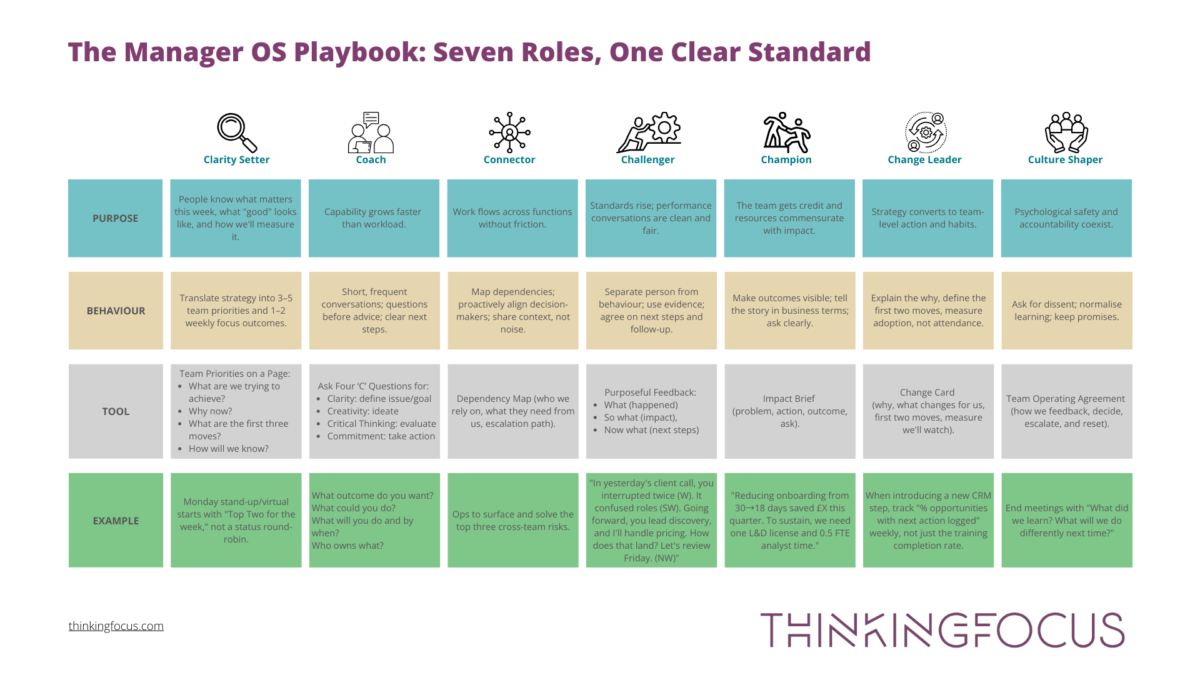
Give managers a simple, shared playbook. One approach that can be used is this “Seven Hats” model, where each hat has a purpose, a core behaviour, and a simple tool.
Clarity Setter
Purpose:People know what matters this week, what “good” looks like, and how we’ll measure it.
Behaviour: Translate strategy into 3–5 team priorities and 1–2 weekly focus outcomes.
Tool:A one-page Team Priorities Summary that answers: “What are we trying to achieve? Why now? What are the first three moves? How will we know?”
Example:Monday stand-up starts with “Top Two for the week,” not a status round-robin.
Coach
Purpose:Capability grows faster than workload.
Behaviour: Short, frequent conversations; questions before advice; clear next steps.
Tool:Ask questions using the four C’s for: Clarity: define issue/goal, Creativity: ideate, Critical Thinking: evaluate, Commitment: take action
Script Starter:“What outcome do you want? What’s in the way? What’s one move you’ll test before Thursday?”
Connector
Purpose:Work flows across functions without friction.
Behaviour: Map dependencies; proactively align decision-makers; share context, not noise.
Tool:Dependency Map (who we rely on, what they need from us, escalation path).
Example:Before a launch, run a 30-minute “pre-mortem” with Sales, Ops, and Legal to surface and solve the top three cross-team risks.
Challenger
Purpose:Standards rise; performance conversations are clean and fair.
Behaviour: Separate person from behaviour; use evidence; agree on next steps and follow-up.
Tool:Purposeful Feedback: What (happened), So what (impact), Now what (next steps)
Example:“In yesterday’s client call (S), you interrupted twice (B). It confused roles (I). Going forward, you’ll lead discovery, and I’ll handle pricing (E). How does that land (C)? Let’s review Friday (N).”
Champion
Purpose:The team gets credit and resources commensurate with impact.
Behaviour: Make outcomes visible; tell the story in business terms; ask clearly.
Example: “Reducing onboarding from 30→18 days saved £X this quarter. To sustain, we need one L&D license and 0.5 FTE analyst time.”
Change Leader
Purpose:Strategy converts to team-level action and habits.
Behaviour: Explain the why, define the first two moves, measure adoption, not attendance.
Tool:Change Card (why, what changes for us, first two moves, measure we’ll watch).
Example:When introducing a new CRM step, track “% opportunities with next action logged” weekly, not just the training completion rate.
Culture Shaper
Purpose:Psychological safety and accountability coexist.
Behaviour: Ask for dissent; normalise learning; keep promises.
Tool:Team Operating Agreement (how we give feedback, decide, escalate, and reset).
Ritual: End meetings with “What did we learn? What will we do differently next time?”
Make the role doable: redesign the work before you train
Training can’t fix a broken job. Start with the job design.
1) Protect a Manager’s Time
Help your managers ring-fence at least 25–35% of each week for management: 1:1s, feedback, planning, and helping them to overcome blockers and obstacles to team success.
Why it matters:
No coach time = confused team, slow progress, and stressed people.
How to do it (three quick moves):
Check the calendar: Mark each meeting as “IC” (individual contributor – doing the work yourself) or “M” (managing/coaching). If “M” time is under 25%, that’s a problem.
Shorten meetings: Make internal meetings 35 minutes by default. Use the saved minutes for coaching and 1:1s.
One in → one out: If you add a new project, pause another. Otherwise, time magically disappears.
Example:
Coach has 40 hours. Protect 10–14 hours weekly for 1:1s, feedback, planning, and fixing blockers. That’s “Coach Time.”
2) Kill Busywork Drag (Reduce Admin Drag)
Busywork = work that doesn’t help the team win (like typing the same info into three systems or waiting for tiny approvals).
Why it matters:
Busywork eats coaching time and makes everyone slower.
How to fix it:
Status lives in a dashboard: Don’t hold a meeting to read updates. Put the numbers in one place, people can check anytime.
Simple approvals: Small spends should need 1–2 clicks, not five signatures.
One template for asks: Use a one-page “Impact Brief”: What’s the problem? What did we try? What did it do? What do we need now?
Example:
Instead of a 45-minute “update” meeting, the team posts updates in the tool. The manager uses those 45 minutes to coach someone who’s stuck.
3) Right-Size the Team & Load (Spans of Control and Individual Contributor load)
A manager shouldn’t have more players than they can coach well, and they shouldn’t be doing so much hands-on work that they can’t coach at all.
Why it matters:
Too many direct reports = rushed check-ins and missed problems.
Too much “doing the work yourself” (IC load) = no time to help others grow.
Easy rules of thumb:
Team size (direct reports):
Manager doing hands-on work (IC load):
Fixes if it’s too heavy:
Add a team lead to help with day-to-day coaching.
Give a coordinator to handle admin and scheduling.
Move a project to another team.
Shrink the scope while the team is new or changing a lot.
Example:
If a manager has 12 new people and a big change project, that’s too much. Reduce reports to 7–8 or add a team lead until the change settles.
4) Make a clear Manager Deal (Before they start)
Write down the rules of the game to avoid any surprises. It’s like a simple contract between the manager, their boss, and HR.
What goes in the deal:
Purpose: One sentence—why this team exists.
Top 3 outcomes: What success looks like this year.
Decisions: Which choices the manager gets to make vs. advise on.
Time & load: Promise the 25–35% coach time and set a limit for hands-on work. Keep the one in → one out rule.
How we work: The Seven Hats (Clarity, Coach, Connector, Challenger, Champion, Change Leader, Culture) with one simple tool for each.
Support: A mentor, a peer group, and a short list of tools/templates.
Rewards: What the pay/praise looks like when they build people and get results.
Boundaries: Quiet hours, meeting-free blocks, and how we cover vacations.
90-day goals: Three clear targets (e.g., 90% of people have 1:1s, blockers get solved faster, one annoying process gets fixed).
Example:
“You’ll have 10–14 hours each week for coaching and planning. If we add a new project, we’ll pause one. You own decisions A and B, and help with C. We’ll measure your success by how your team grows and how fast work moves, not just by raw output.”
Build Skills That Stick
Think of a manager like a team coach who’s also still learning. To get better, you don’t need long classes; you need short, regular practice on real stuff. Practice beats PowerPoints.
1) Tiny weekly drills (15 minutes)
What: One small skill, once a week, for 15 minutes.
Why: Short, focused practice sticks.
How: Pick one drill; try it the same week.
Month 1 example
Week 1 – Purposeful feedback: Tell someone clearly what happened, why it mattered, and what to do next.
Week 2 – Better 1:1s: Use a simple agenda: check-in → priorities → blocker → coaching → feedback → commit.
Week 3 – Set the “Top Two”: Name the two most important outcomes for the team this week.
Week 4 – Remove a blocker: Map who you need help from and ask for a yes/no decision.
2) Manager circles = practice squad
What: 6–8 managers meet for 45 minutes every two weeks.
Why: You learn faster together.
How it works (simple rules below):
One person brings a real problem.
The group uses this week’s drill to help.
The owner picks one action to try before the next circle.
Next time, they share what happened (win or learn).
3) Just-in-time resources (keep them accessible)
What: One-page guides and 2-minute videos.
Where: Calendar invites, CRM notes, project tool, team wiki.
Why: When the moment comes, you don’t have time to search a big manual.
Examples:
“Purposeful Feedback” card (What | So What | Now what)
“Top Two” weekly sheet
“Dependency Map” checklist (who we rely on, what they need, who decides)
“What Would You Do?” is a social space where managers can discuss everyday dilemmas in a safe environment, learning from each other and sharing experiences.
4) Stretch chances (but with a safety net)
What: Small “try it for real” opportunities.
Why: Confidence grows by doing, not by reading.
Examples:
Run one work-experience day or a mini project.
Lead part of a team meeting (e.g., the “Top Two”).
Shadow a tough conversation, then try the next one with support.
Safety net: Agree on the goal, boundaries, and who has your back.
5) Simple reflection = faster learning
5-minute weekly check (write it in the 1:1 doc):
What did I try?
What worked?
What didn’t?
What’s one change for next time?
Traffic light: Green = good; Amber = bumpy; Red = need help.
Reward the work that creates value
Incentives drive behaviour. Adjust them visibly.
Compensation and recognition.
Make the manager premium explicit. Tie a portion to capability outcomes (internal promotions, skill lift) as well as business results.
Publicly celebrate “manager moments” (where appropriate, consider private where preferences dictate) in all-hands: name the behaviour and the impact, not just the metric.
Dual tracks with parity.
Ensure technical and managerial tracks can both reach top pay bands. People shouldn’t have to manage to progress – but if they choose to operate, they should see a clear upside.
Progression markers.
Move beyond “team size” as a proxy. Use complexity handled, talent developed and cross-functional impact delivered as the badge of seniority.
Measure what matters (leading indicators beat lagging ones)
Don’t wait for annual engagement scores. Track simple, behavioural signals:
Manager activity: % of team with a monthly 1:1; # of purposeful feedback moments logged per month. Aim for 90%+ 1:1 coverage; “two pieces of feedback per person per month” as a norm.
Talent signals: Internal fill rate for key roles (target 60%+); time-to-productivity for new hires (trend down month-on-month); regretted attrition of high performers (trend down).
Execution health: Cross-functional cycle time (request → decision); blocker removal time; change adoption (measurable behaviour, not attendance).
Wellbeing risk: Calendar load, after-hours send ratio, self-reported workload control. Use thresholds to trigger a coaching check-in, not a reprimand.
Publish the dashboard by division. Celebrate improvements loudly and share the playbooks that drove them.
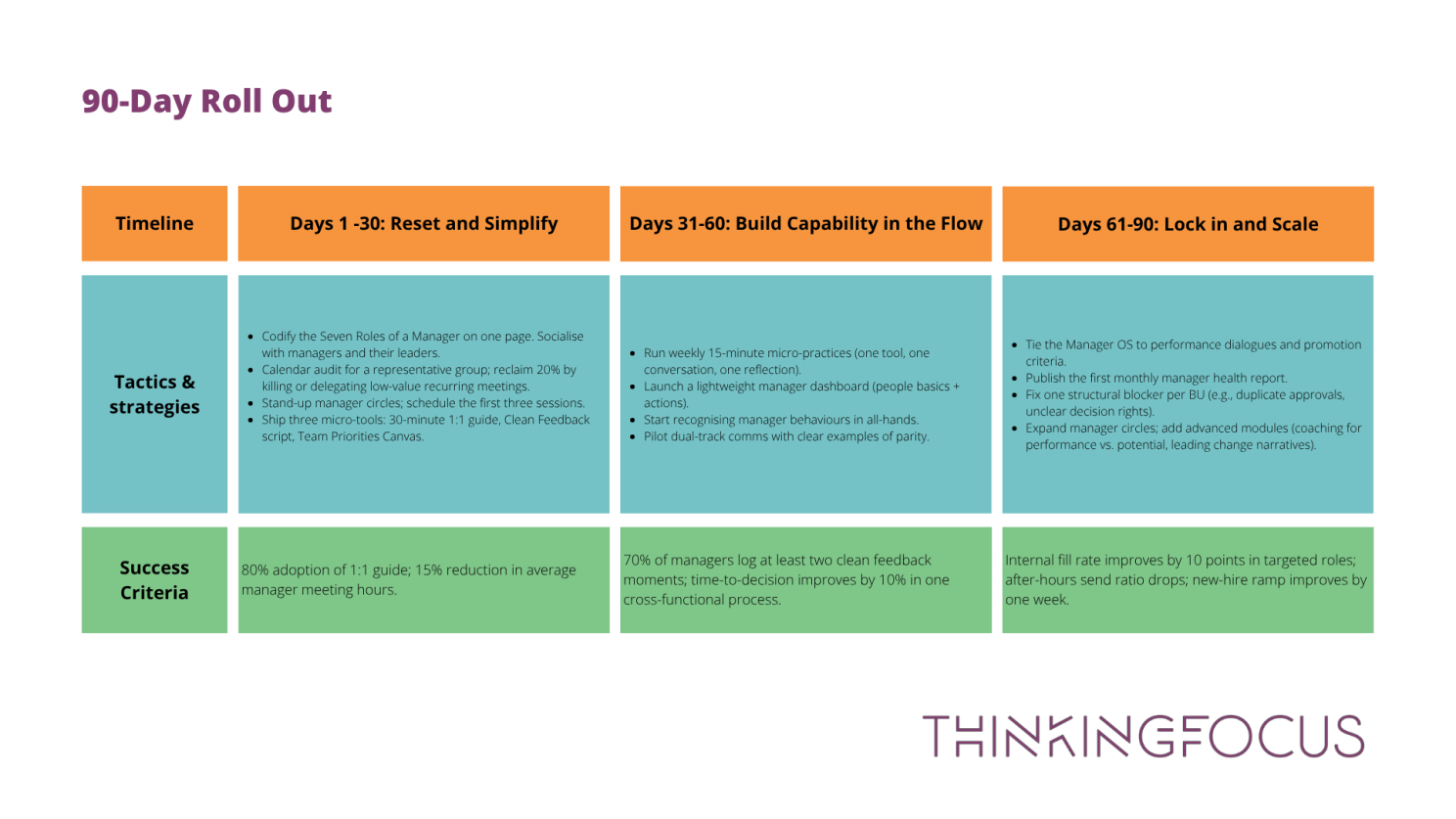
A 90-day rollout you can start next week
Days 1–30: Reset and simplify
Codify the Seven Hats on one page. Socialise with managers and their leaders.
Calendar audit for a representative group; reclaim 20% by killing or delegating low-value recurring meetings.
Stand-up manager circles; schedule the first three sessions.
Ship three micro-tools: 30-minute 1:1 guide, Clean Feedback script, Team Priorities Canvas.
Success criteria: 80% adoption of 1:1 guide; 15% reduction in average manager meeting hours.
Days 31–60: Build capability in the flow
Run weekly 15-minute micro-practices (one tool, one conversation, one reflection).
Launch a lightweight manager dashboard (people basics + actions).
Start recognising manager behaviours in ‘all-hands’/’town hall’ meetings.
Pilot dual-track communications with clear examples of parity.
Success criteria: 70% of managers log at least two clean feedback moments; time-to-decision improves by 10% in one cross-functional process.
Days 61–90: Lock in and scale
Tie the Manager OS to performance dialogues and promotion criteria.
Publish the first monthly manager health report.
Fix one structural blocker per Business Unit (e.g., duplicate approvals, unclear decision rights).
Expand manager circles; add advanced modules (coaching for performance vs. potential, leading change narratives).
Success criteria: Internal fill rate improves by 10 points in targeted roles; after-hours send ratio drops; new-hire ramp improves by one week.
Objections you’ll hear – and how to respond
“We don’t have time.” You don’t have time not to. Reclaiming 20% calendar time typically returns more capacity within two weeks than any single headcount request.
“Some people don’t want to manage.” Good. Keep dual tracks. But for those who do, make it a craft worth mastering.
“Our environment is unique.” The hats are universal; the examples are yours to tailor. Start with one team, one Business Unit, one quarter.
What this changes – for real
Employees feel led, not just managed. Clear expectations, fair feedback, visible growth.
Managers regain pride and energy. The job is doable, valued and supported.
Leaders see throughput. Faster decisions, stronger execution, healthier succession.
If you don’t invest here, the gap doesn’t stay empty; it fills with inconsistency, mixed signals and avoidable attrition. If we do invest, managers become what we desire and intend: the multiplier of your strategy.
Where to begin:
If the thoughts in this newsletter have caused you to pause, and you think you could do more to support your managers differently (or if you are a manager and you think you could be working differently), consider the following:
This week, protect two hours in managers’ calendars. Roll out the 20-minute 1:1 (wins (from last week), learnings (from last week), focus for the week ahead, and help required). Convene your first manager circle.
Next week, teach Purposeful Feedback and require one live practice per manager.
By the end of the month, publish your first manager health snapshot. Momentum beats perfection. The role of the manager is too important to leave to chance.
Consider the Social Learning Experience that blends gamification with group coaching and psychological safety – accelerate your development and raise the bar of your managers – introducing ‘What Would You Do?’
When we change how we work, however much planning and training we put in place up front, we still need to allow a period when things will get worse before they get better. We may need time to adapt to new processes, systems, or unlearn old ways of doing things.
Who wants to get worse at their job? Instead of embracing the discomfort of change, most of us cling to the old ways we understand, hoping to stay within our comfort zone.
In this podcast, Richard and Graham explore why this happens, and what leaders and managers can do to help people through this transition, live with the discomfort long enough to embed the new skills, processes and approaches that will allow them to benefit from the improved productivity that was always envisaged when the new way of working was first dreamed up.
In this episode of The Question, Ricky and Graham continue from episode 147, exploring the impact of constant change on teams.
The modern world of work is one of constant evolution, which, for some, can be a great opportunity. Still, for many, it feels relentless, risking creating change fatigue in the people you rely on to make the change work.
Change is a mixture of practical and people outcomes, and leaders can easily focus on the practical deliverables, leaving the people to transition to the change on their own. Graham and Ricky explore the practical things that managers and leaders can do that will help people move from surviving change to embracing the opportunities that change presents.
Sometimes, it feels like the workplace has become a place of constant change, with technology, economics and societal changes driving the need for teams to adapt how they work to meet changing needs constantly. Leaders who can help their teams embrace new ideas and working practices can drive the performance of their teams while at the same time protecting those they work with from the stress we feel when change is imposed on us.
In this episode of The Question Is, Ricky and Graham explore the leader’s role in preparing their team in advance, creating a culture where change is embraced, not fought. They offer simple, practical steps, from explaining the change’s purpose to creating a clear vision of how the new ways of working will actually work. If you have teams that are experiencing change, this podcast will help you help them.
In this podcast, Richard and Ricky explore some practical things you can do to build the culture in your organisation.
Organisational Culture is a big topic, and often, you can get lost in the plethora of models and ideas. Culture feels big and something the most senior people have to take action on. Yet there are some simple, practical steps that any of us can take to improve the culture, even if it is just for our team.
From establishing the group’s purpose, discovering the values, and aligning the business practices around measurement, reward and processes, manager have much more control over the culture of their team than they might believe.